
Fiber Gel vs. Powder vs. Gummies vs. Capsules
October 24, 2026 · Evelyn Noh
Which Fiber Format Is Easiest to Take Every Day?
The easiest fiber format is the one you will actually take every day. Powders give you well-studied fiber like psyllium at a low cost, but you have to mix them into a full glass of liquid. Capsules have no taste, but you swallow several pills for about 2 grams of fiber. Gummies are the most pleasant, but many deliver around 5 grams per serving. A ready-to-eat fiber gel gives you a full dose with no mixing, which makes it the simplest option if powders and pills have not stuck for you.
Quick answer
You don't mind mixing a drink
Psyllium powder
You need only a small top-up
Capsules or gummies
You want a full serving, zero prep
Spoonable fiber gel
Whatever you choose
Start small, add water
Why does the format of your fiber supplement matter?
Most adults are not getting enough fiber, so the best format is the one you can take consistently. The FDA's Daily Value for dietary fiber is 28 grams, and age and sex targets in the 2020-2025 Dietary Guidelines for Americans range from 22 to 34 grams a day. Yet only about 5% of U.S. adults reach their target, and most eat around 16 grams a day, according to Cleveland Clinic. The 2025-2030 Dietary Guidelines, released in January 2026, continue to prioritize fiber-rich whole foods.
The fiber gap
Only about 1 in 20 U.S. adults reach their daily fiber target.
Source: FDA Daily Value; Cleveland Clinic, 2025.
Food should come first. Mayo Clinic recommends eating a wide variety of high-fiber foods and using supplements to help fill the gap. When you do use a supplement, a format you dislike becomes a habit you skip. Taste, prep time and how many grams you get per serving decide whether a supplement closes the gap or sits in the cupboard.
Fiber formats at a glance
Fiber per serving
Each bar shows one label serving against the 28 g Daily Value.
Typical amounts based on common products available in 2026. Formulas vary, so always check your product's label.
Fiber powders: the most studied, but you have to mix them
Powders are the classic choice, and psyllium powders have the most research behind them. In 2023, the American College of Gastroenterology and the American Gastroenterological Association jointly suggested fiber supplements for adults with chronic constipation, a conditional recommendation based on low-certainty evidence that covered psyllium, bran and inulin.
The trade-off is the routine. You measure, stir into at least 8 ounces of liquid and drink it before it thickens. If the texture or the extra step bothers you, it becomes easy to skip days.
Best for: people on a tight budget who don't mind mixing a drink every day.
Capsules: no taste, but a lot of pills
Capsules remove texture and taste from the equation. The catch is the dose. A typical psyllium capsule product lists about 5 capsules per serving for around 2 grams of fiber, and it still needs a full glass of liquid. Reaching even half of the 28-gram Daily Value with capsules alone is not realistic for most people.
Best for: a small daily top-up when you already eat plenty of fiber.
Gummies: easy to take, but low fiber per serving
Gummies are the most enjoyable format, and they need no water or prep. Many deliver a modest amount, around 5 grams per serving of 2 to 3 gummies, often from inulin or soluble corn fiber. "No sugar added" versions often use sugar alcohols like xylitol, which can upset sensitive stomachs. Check the label for sugar, sugar alcohols and grams of fiber per serving.
Best for: people who want a small, pleasant boost and don't need a large daily dose.
Fiber gel: ready to eat, with a full dose in one serving

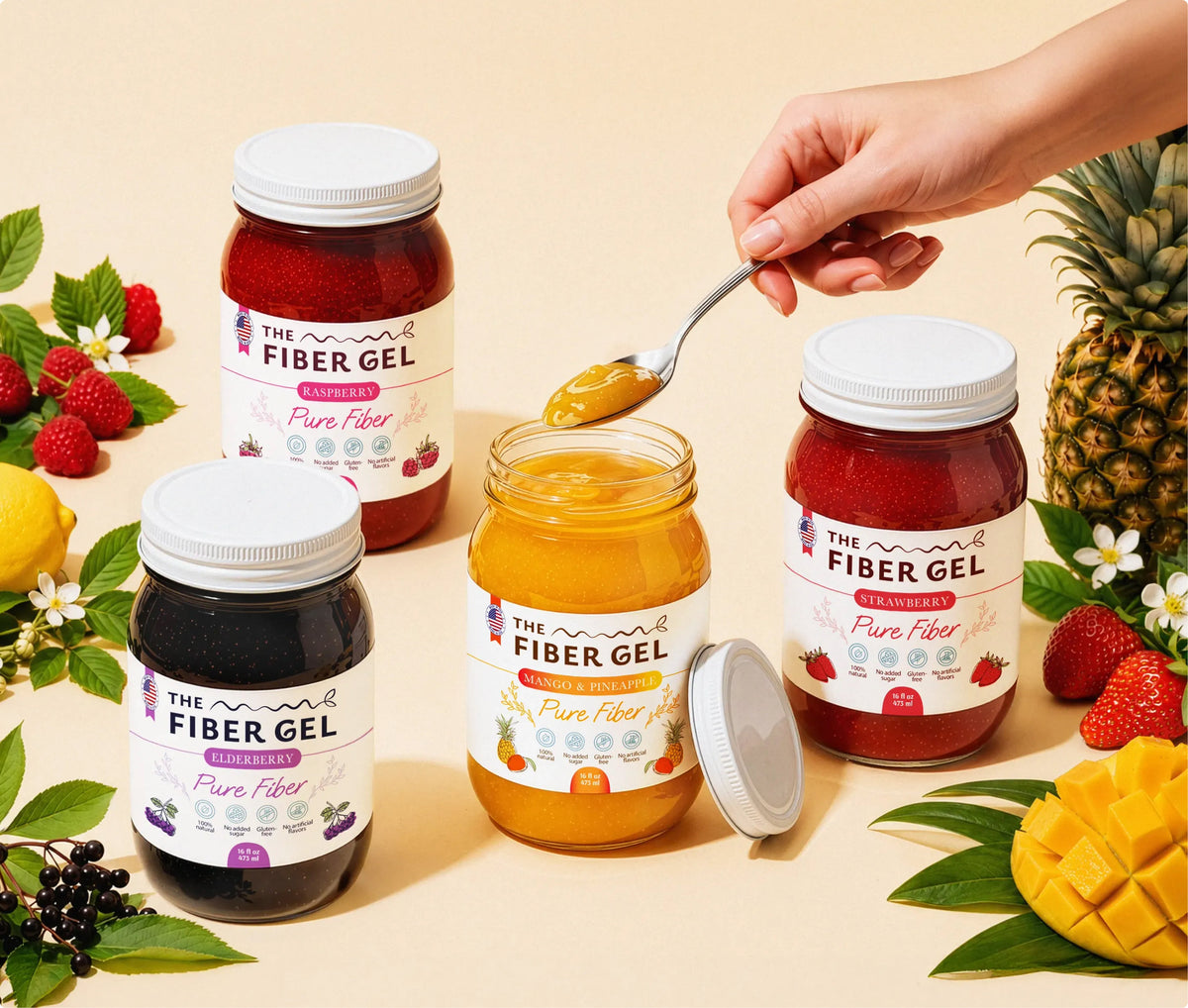
A fiber gel is fiber that is already prepared in a smooth, spoonable form, so there is nothing to mix, dissolve or swallow whole. You eat it from the spoon or stir it into yogurt, oatmeal or a smoothie.
The Fiber Gel is one example. One serving (4 tbsp) delivers 23 grams of fiber, or 82% of the Daily Value, from three sources:
1
Psyllium husk
A well-studied fiber that adds bulk and supports regularity.
2
Chicory root inulin
A prebiotic fiber that feeds beneficial gut bacteria.
3
Pectin
A soluble fiber naturally found in fruit.
Psyllium husk and pectin are on the FDA's list of isolated fibers that count as dietary fiber on the Nutrition Facts label. The FDA allows inulin-type fructans to be declared as dietary fiber while it completes rulemaking to add them to that list.
The trade-offs: a jar needs refrigeration once opened, it's less pocketable than a few capsules, and inulin can cause temporary gas when you first add it. Start with 1 tablespoon a day and build up.
Best for: people who dislike powders and pills and want a meaningful amount of fiber in one easy step.
Which fiber format should you choose?
How do you start a fiber supplement without bloating?
Whatever format you pick, go slow. Mayo Clinic notes that fiber supplements can cause bloating, cramping and gas, especially at a high starting dose, and recommends beginning low and increasing gradually.
Your start plan
Start small. Try 1 tablespoon of fiber gel or 1 serving of a powder, once a day.
Build up slowly. Increase every few days as your body adjusts.
Drink enough water. Powders and capsules typically call for at least 8 ounces of liquid per dose.
Space out medications. Take them 1 hour before or 2 hours after fiber, as Mayo Clinic advises, and ask your pharmacist if you take prescriptions.
Check in with your doctor if you have ongoing constipation, a digestive condition or trouble swallowing.
How The Fiber Gel fits

The Fiber Gel is a ready-to-eat, spoonable prebiotic fiber gel. One serving (4 tbsp) delivers 23g of 3-in-1 fiber (soluble, insoluble and prebiotic) from psyllium husk, chicory root inulin and pectin, made with real fruit and sweetened with monk fruit, with no added sugar.
23 g
fiber per serving
0 g
added sugar
40
calories per serving
6
real-fruit flavors
- Fat-free, vegan, keto-friendly and gluten-free
- Strawberry, Raspberry, Mango, Mango & Pineapple, Elderberry and Banana
- Made in the USA in an FDA-registered facility and third-party tested
Mix, match, save.
Build a box of mixed flavors and save up to 51% with multi-jar and Subscribe & Save pricing.
Build my boxFAQ
Is a fiber gel as effective as a fiber powder?
It depends on the fiber inside, not the format. Psyllium works the same way whether it's in a powder or a gel. Compare the type of fiber and the grams per serving on the label.
Do I still need to drink water with a fiber gel?
Yes. A fiber gel is already made with water, but fiber works best when you drink enough water through the day.
Can fiber gummies replace high-fiber foods?
No. At around 5 grams per serving, gummies can help fill a small gap. Whole grains, beans, fruits and vegetables should still be the base of your fiber intake.
How much fiber should I take from a supplement?
Aim for a daily total of about 28 grams from food and supplements combined. Count what you already eat, then use a supplement to close the gap, building up slowly.
Can I split a serving of fiber gel?
Yes. You can have 2 tablespoons in the morning and 2 later in the day.
Sources
- U.S. Food and Drug Administration. Daily Value on the Nutrition and Supplement Facts Labels.
- U.S. Food and Drug Administration. Questions and Answers on Dietary Fiber.
- Cleveland Clinic. How Much Fiber Do You Need per Day? April 30, 2025.
- Harvard T.H. Chan School of Public Health, The Nutrition Source. Dietary Guidelines for Americans 2025-2030. January 9, 2026.
- Mayo Clinic News Network. What's the best way to boost your fiber intake? August 10, 2021.
- American College of Gastroenterology and American Gastroenterological Association. Joint guideline on chronic idiopathic constipation. May 22, 2023.
*These statements have not been evaluated by the Food and Drug Administration. This product is not intended to diagnose, treat, cure, or prevent any disease. This article is for general information and is not medical advice.
Ready to feel the difference?
Build my box